The Hawaiian Archipelago
The name Ko Hawaiʻi Pae ʻĀina refers to the Hawaiian archipelago: pae ʻāina is the Hawaiian term for a group of islands. This is a short guide to the land and waters our name describes.
A chain built over a hot spot
The islands were built by volcanism at a hot spot, a point where magma rises through the middle of a tectonic plate. The hot spot stays in place while the Pacific Plate moves northwest above it, so the islands formed one after another in a line. As NOAA explains, each island or submerged seamount in the chain is successively older toward the northwest.
That is why the archipelago is arranged the way it is. Hawaiʻi Island, at the southeastern end, is the youngest of the main islands. Farther southeast, Loʻihi is a submarine volcano still erupting from a summit about 1,000 meters below the surface. Toward the northwest, the islands are older and lower, worn down into small islands, atolls, and reefs that end at Kure Atoll (Hōlanikū).
The eight main islands
Most people know the archipelago through its eight main islands. Hawaiʻi Island is by far the largest. At 4,028 square miles it is larger than the other seven main islands combined.
| Island | Square miles | Square kilometers |
|---|---|---|
| Hawaiʻi | 4,028.42 | 10,433.55 |
| Maui | 771.99 | 1,999.45 |
| Oʻahu | 597.64 | 1,547.88 |
| Kauaʻi | 552.35 | 1,430.59 |
| Molokaʻi | 260.46 | 674.58 |
| Lānaʻi | 141.07 | 365.36 |
| Niʻihau | 67.60 | 175.09 |
| Kahoʻolawe | 44.60 | 115.50 |
Swipe sideways to see all columns.
Source: State of Hawaiʻi, Department of Business, Economic Development & Tourism, from 2010 Census data.
Beyond the main islands
Northwest of Kauaʻi and Niʻihau the chain continues for more than a thousand miles as the Northwestern Hawaiian Islands. Their combined land area is only about 3.1 square miles, yet they are among the most significant places in the archipelago, culturally and ecologically. We look at them in Papahānaumokuākea: The Northwestern Chain.
The motto on our arms
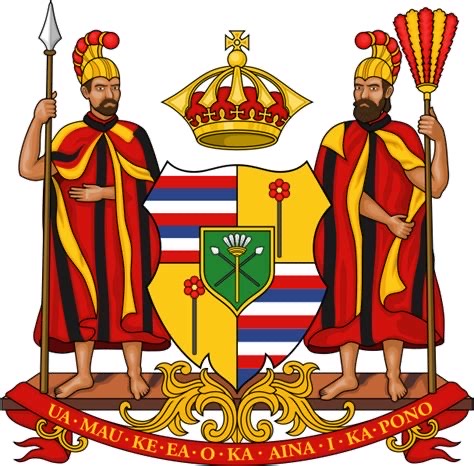
The ribbon beneath the coat of arms of Ko Hawaiʻi Pae ʻĀina reads Ua Mau ke Ea o ka ʻĀina i ka Pono: “The life of the land is perpetuated in righteousness.”